


The surprising history of Cartier’s crocodile necklace
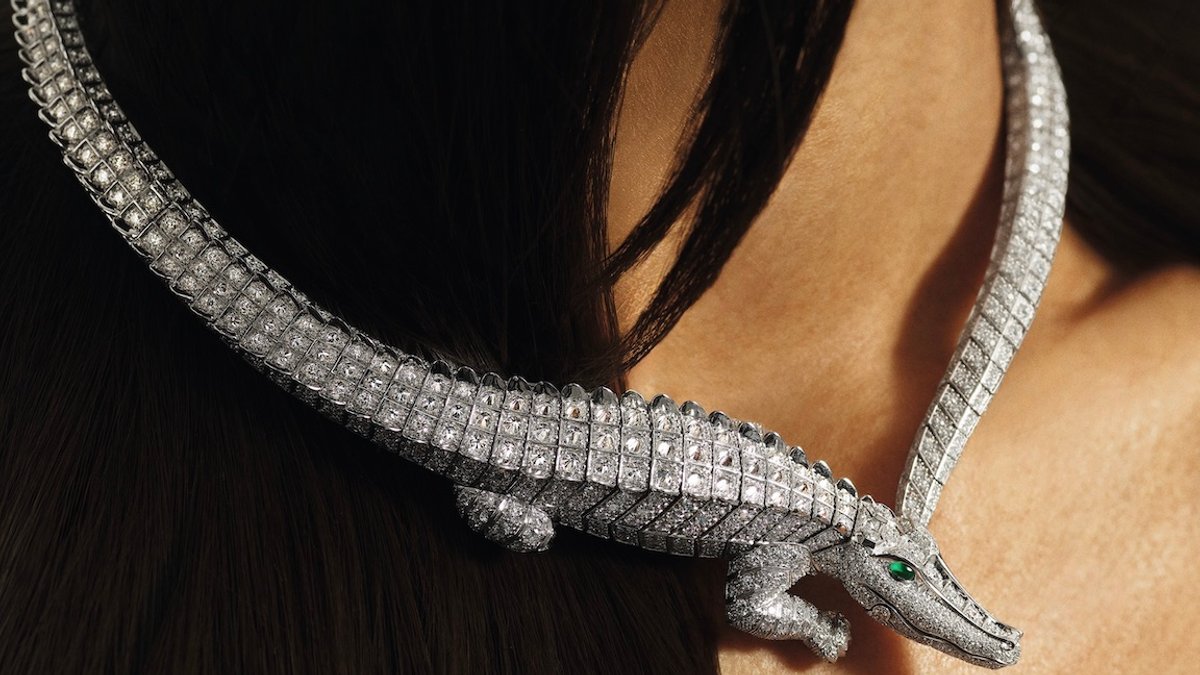
The Cartier Crocodile necklace has an origin story almost too extraordinary to believe, living on as a prime example of the duality of diamond jewelry as fine art. The reptilian brain is the oldest, innermost part of the human brain, responsible for primal survival functions. It’s only fitting, then, that the famed Cartier Crocodile necklace triggers an instinctual response of its own—with an extraordinary backstory and craftsmanship so impeccable it takes your breath away.
A Living Reptile as Inspiration
More than 50 years after it was first commissioned by Mexican actress María Félix, the Cartier Crocodile necklace remains one of the most extraordinary creations in high jewelry. Composed of thousands of emeralds and yellow diamonds, the spectacular piece is matched only by its origin story: a remarkable tale you can really sink your teeth into. “There’s nothing really like it in the world,” says jewelry historian Helen Molesworth.
Helen Molesworth is a renowned jewelry historian, gemologist, and best‑selling author. Her 25‑year career has spanned the global gem and jewelry industry from auction houses to academic posts. She acted as a jewelry specialist for Sotheby’s and Christie’s, where she researched and managed iconic jewelry collections. In her role as Senior Curator of Jewelry at the Victoria and Albert Museum in London, Molesworth led the blockbuster exhibition “Cartier” and released a book on the subject with V&A Publishing in 2025.
Cartier has an enduring passion for the natural world. The historic French luxury jeweler maintains a vision of glamorous wildlife, using expert knowledge of stones, dynamic shapes, and daring colors to depict its menagerie of flora and fauna motifs. The iconic Panther, for example, was reimagined by the house in 1948 for the Duchess of Windsor. Its storied Director of Fine Jewelry, Jeanne Toussaint, is even said to have asked designers to spend time at the Paris Zoo for design cues.
“Lions, and tigers, and bears, oh my!” gets a diamond‑studded makeover with panthers, tigers, snakes, and yellow diamond crocodiles. Here, discover the extraordinary history behind the iconic Cartier Crocodile necklace.
The Surprising Origin Story
In 1975, María Félix strolled into the Cartier boutique at 13 Rue de la Paix in Paris to request a special order. As the legend goes, the Mexican actress was accompanied by a real baby crocodile for the designers to use as inspiration. She wanted Cartier’s expert jewelers to replicate the crocodile’s features as accurately as possible.
Related: Diamond Chain is Summers Hottest Jewelry Trend
“She obviously loved very bold jewelry and decided that she wanted Cartier to make her this Crocodile necklace,” says Cartier author Helen Molesworth. “She turned up to Cartier Rue de la Paix in Paris with a baby crocodile and said, ‘Make it like this.’”
While some claim she carried a live baby crocodile in a jar, others have described the enclosure as an aquarium. Rumor has it she even suggested her little pets stay at Cartier for a while for further inspection as a design reference. As the Lead Curator of the V&A’s blockbuster Cartier exhibition and author of its accompanying tome, Molesworth has heard every rendition of this incredible tale.
Pierre Rainero, Cartier’s director of image, style, and heritage, told the outlet he personally asked Félix about the grandiose story back in 1999, and she confirmed. However, he notes she had a reputation for embellishing.
“It’s magnificent,” shares Molesworth. “When you look at the crocodiles, you can see that they must have been modeled very close to real‑life examples,” she explains. “There’s just something in their faces that is so realistic.”
Masterful Craftsmanship
Cartier Crocodile Necklace, 1975. (Courtesy of Cartier)
After meticulous study and endless hours of sketching, the house’s revered artisans masterfully executed a necklace featuring two gold articulated crocodiles, hugging around the neck. One consists of 1,060 emeralds and two cabochon rubies for its eyes, while its twin is paved with 1,023 yellow diamonds.
Related: Grace Kellys iconic diamond ring
Molesworth says, “The snout of one of them reaches up ever so slightly more than the other. They’ve got this lovely curve to the snout, they’ve got this crown over the eyes, and the movement in the tail, with the fatness of the body. The way they’ve been built, it’s very lifelike. You look at their faces, and you can genuinely imagine a real crocodile in the water.” She continues, “It feels like they’re actually going to raise their head and bite you. They look very realistic.”
Each half of the necklace can even be removed and worn separately as two three‑dimensional brooches. The perfect example of jewelry as art, the impeccably constructed jewel doubles as a stunning sculpture. Félix reportedly even used them as captivating table ornaments during dinner parties.
While Félix’s iconic commission lives on as the most memorable Cartier crocodile, reptiles have had their place in the menagerie of the historic French jewelry house since the early 20th century.
Modern Revivals and Wearers
María Félix sold most of her jewelry right before she died in 2002. Cartier then reacquired the emerald and yellow diamond crocodile jewel, now included in the jeweler’s patrimonial collection. After Félix, Italian actress Monica Bellucci became the second person to ever wear the legendary necklace. She walked the red carpet at the Cannes Film Festival in 2006, displaying the piece with a crisp white shirt.
Since then, Egyptian actress and model Yasmine Sabri wore the piece to a Cartier event in 2021, and Mexican actress Mabel Cadena sported the necklace for her March 2023 Vogue México cover shoot, making for a total of four women in the world to don the exquisite masterpiece.

Carrie Bradshaw's 10 Bold Jewelry Highlights

